
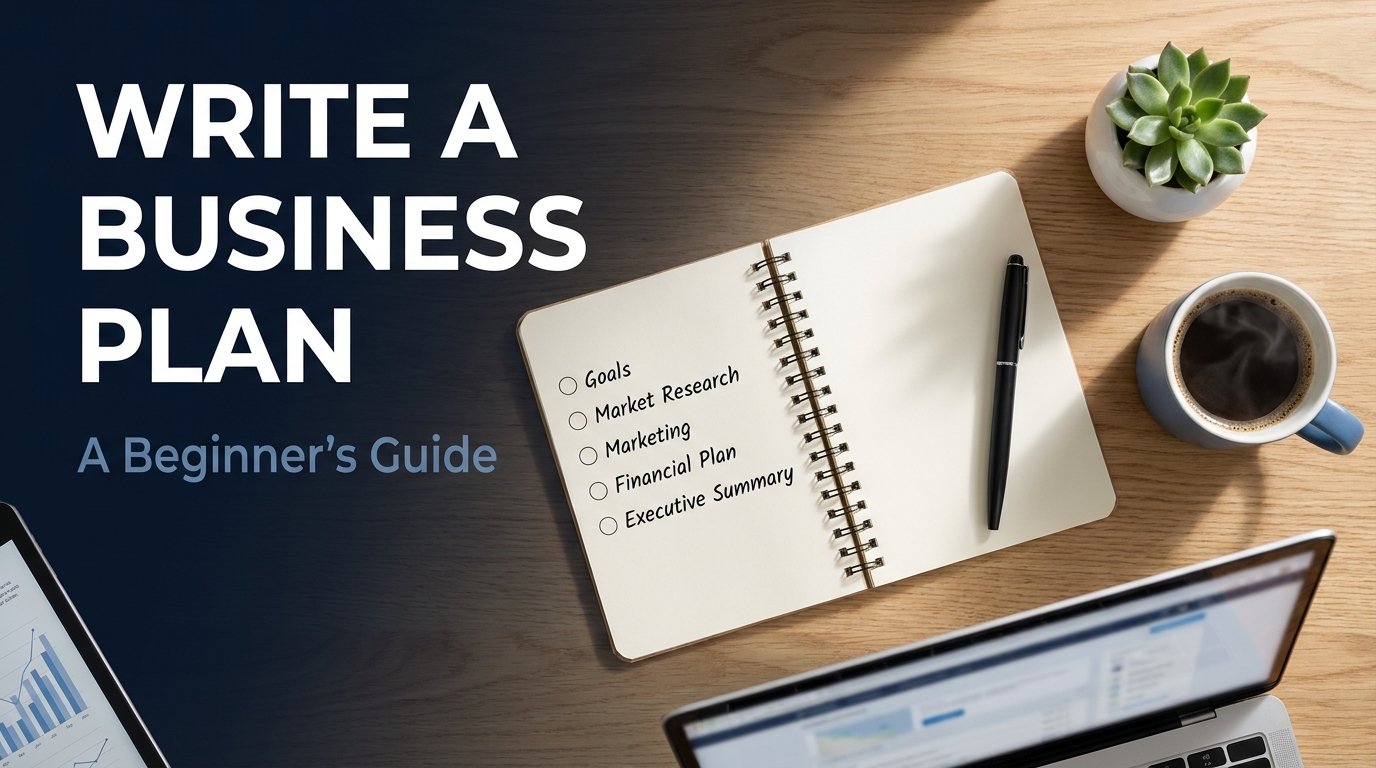
Starting a business begins with an idea, but turning that idea into a workable business requires planning. You need to understand your customers, estimate your expenses, decide how you will make money, and determine how you will attract buyers.
Learning how to write a business plan helps you organize these decisions before investing significant time or money. A business plan gives you a practical roadmap for launching, managing, and developing your business.
The good news is that you do not need to be an experienced entrepreneur to create one. This beginner-friendly guide explains the main sections of a business plan, how to prepare each section, and how to use a simple outline to get started.
What Is a Business Plan?
A business plan is a written document that describes your business, its target customers, the products or services it offers, its marketing approach, and its financial expectations.
It helps you turn a general business idea into a structured plan of action. You can use it to guide daily decisions, evaluate risks, communicate with potential partners, and prepare for discussions with lenders or investors.
A business plan can be relatively short when you are testing an idea. A business seeking outside investment or operating in a complex industry may need a more detailed document.
Why Is a Business Plan Important?
- Clarifies your goals: It helps you define what you want your business to achieve.
- Identifies your customers: It encourages you to understand who is likely to buy your products or services.
- Supports financial planning: It helps you estimate startup costs, operating expenses, revenue, and cash requirements.
- Improves decision-making: It gives you a framework for comparing opportunities and risks.
- Communicates your strategy: It explains your business model to potential partners, lenders, and investors.
A business plan cannot guarantee success, but it can help you identify unanswered questions and make more informed decisions.
How to Write a Business Plan Step by Step
Step 1: Write an Executive Summary
The executive summary provides a brief overview of your business and the plan that follows. Although it appears first, it is often easier to write it after completing the other sections.
Your executive summary should explain:
- Your business name and what the business does.
- The product or service you intend to offer.
- The customers you want to serve.
- The problem your business solves.
- Your main business goals.
- Your basic revenue model.
- Any funding requirements, if applicable.
Example: A small online stationery business might summarize its plan by explaining that it sells customizable planners and notebooks to students, professionals, and people who enjoy organized planning.
Keep the summary clear and focused. A reader should understand the basic business concept without needing to read the entire document.
Step 2: Describe Your Business
This section explains what your business does, why it exists, and how it intends to serve customers.
Include information such as:
- Your business name and proposed location.
- Your industry and business model.
- The products or services you will provide.
- The customer problem you intend to solve.
- Your business goals and long-term direction.
- Your intended legal structure, once determined.
Explain what makes the business useful to its customers. Avoid relying on vague statements such as "we provide the best service." Describe the specific value customers can expect.
Step 3: Identify Your Target Market
Your target market consists of the people or organizations most likely to purchase your product or service.
Trying to sell to everyone can make your marketing expensive and unfocused. A clearer understanding of your ideal customer helps you develop more relevant products, prices, and promotional messages.
Research the following areas:
- Customer characteristics: Consider relevant factors such as age range, location, occupation, income level, or business size.
- Customer needs: Identify the problems your potential customers want to solve.
- Buying behavior: Explore how customers currently find and purchase similar products.
- Market demand: Look for evidence that people need or are willing to pay for your offer.
- Competitors: Study existing alternatives and identify opportunities to differentiate your business.
You can conduct initial research through customer interviews, surveys, competitor websites, industry publications, and publicly available market information.
Separate facts from assumptions. If you have not yet confirmed that customers will buy your product, describe this as something you need to test rather than presenting it as established demand.
Step 4: Analyze Your Competition
Competitor research helps you understand the alternatives customers already have and how your business could stand out.
Identify a few relevant competitors and examine:
- The products or services they offer.
- The customer groups they serve.
- Their publicly listed prices and service packages.
- Their marketing channels and brand positioning.
- Customer feedback and recurring complaints.
- Potential gaps in their offerings.
Use your findings to identify a realistic competitive advantage. This might involve specialization, convenience, product quality, customer service, a distinct design, or a different delivery method.
Your goal is not to copy competitors. It is to understand the market and determine why customers might choose your business instead.
Step 5: Explain Your Products or Services
Describe exactly what you intend to sell and how it benefits your target customers.
For each major product or service, consider including:
- A clear description of the offer.
- The customer problem it addresses.
- The main features and benefits.
- Your proposed pricing approach.
- How you will deliver the product or service.
- Any important suppliers, equipment, or resources required.
For example, a freelance graphic designer might offer logo design, brand identity packages, and ongoing design support. Each service would have a defined scope, pricing method, and delivery process.
If your product is still being developed, explain its current status and the steps required before launch.
Step 6: Create a Marketing and Sales Plan
A useful business plan explains how potential customers will discover your business and how you will turn their interest into sales.
Your marketing and sales plan should cover:
- Positioning: How you want customers to understand your business.
- Marketing channels: Where you will reach potential customers.
- Content strategy: What useful information or promotional content you will create.
- Sales process: How customers will inquire, purchase, and receive your offer.
- Customer retention: How you will encourage satisfied customers to return.
- Marketing budget: How much you can reasonably spend on promotion.
Possible marketing channels include search engines, social media, email newsletters, partnerships, referrals, local networking, and paid advertising.
Choose channels that fit your customers and available resources. A business serving local homeowners may benefit from local search visibility and referrals, while a software company may focus on educational content, demonstrations, and targeted outreach.
Set measurable objectives, such as generating qualified inquiries, increasing repeat purchases, or improving conversion rates. Review the results and adjust your approach when the evidence suggests a change is needed.
Step 7: Plan Your Operations
The operations section explains how your business will deliver its products or services consistently.
Depending on your business, include details about:
- Your work location or online operating setup.
- Equipment, technology, and other essential resources.
- Suppliers and inventory requirements.
- Production or service delivery processes.
- Staffing and responsibilities.
- Customer support and quality control.
- Important legal, licensing, or insurance requirements.
Think through what must happen between receiving an order and delivering the final product or service.
For example, an online store may need a reliable supplier, an order management process, packaging materials, a delivery partner, and a method for handling returns.
Document the main steps and identify possible bottlenecks before they become expensive problems.
Step 8: Prepare Your Financial Plan
The financial section estimates what your business will cost to operate and how it may generate revenue.
For a new business, begin with the following elements.
Startup Costs
List the one-time or initial expenses required to launch the business. These may include equipment, website development, registration fees, initial inventory, deposits, and professional services.
Operating Expenses
Estimate recurring costs such as rent, software subscriptions, wages, utilities, insurance, delivery, and marketing.
Revenue Projections
Estimate the number of sales you may achieve and the average amount customers will pay. Explain the assumptions behind your estimates rather than presenting uncertain figures as guaranteed outcomes.
Profit and Loss
Estimate revenue and subtract the relevant costs and expenses to understand whether the business could be profitable.
Cash Flow
Estimate when money will enter and leave the business. A business may report sales but still struggle to pay its bills if customers pay late or large expenses occur before revenue arrives.
Break-Even Analysis
Break-even analysis estimates how many units you must sell to cover your fixed and variable costs.
For a business selling one main product, the basic formula is:
Break-even units = Fixed costs ÷ (Selling price per unit − Variable cost per unit)
For example, suppose your monthly fixed costs are $1,000, your selling price is $50 per unit, and your variable cost is $30 per unit.
Your contribution per unit is $50 − $30 = $20.
Your break-even point is $1,000 ÷ $20 = 50 units per month.
Under these assumptions, you would need to sell 50 units per month to cover the stated costs. This simplified calculation assumes the selling price, variable cost per unit, and fixed costs remain constant. Taxes, financing costs, and other expenses may require additional analysis.
Use realistic assumptions and update your financial estimates as you learn more about actual costs and customer demand.
Step 9: Set Goals and Milestones
Turn your business plan into a practical action plan by setting clear goals and deadlines.
Examples of early milestones include:
- Complete customer research.
- Finalize the initial product or service offer.
- Calculate startup costs.
- Build a basic website or sales page.
- Contact potential customers.
- Complete an initial sales test.
- Review revenue, expenses, and customer feedback.
Give each milestone a deadline and identify the resources needed to complete it.
Focus first on the activities that reduce uncertainty, such as testing customer demand and confirming whether your pricing can support the business.
Simple Business Plan Template for Beginners
You can use the following outline to begin writing your own business plan. Add more detail where your business requires it.
- Executive summary: What does your business do, who does it serve, and what are your main goals?
- Business description: What products or services will you offer, and what customer problem will you solve?
- Target market: Who are your ideal customers, and what evidence supports your understanding of their needs?
- Competitor analysis: What alternatives exist, and how will your business differentiate itself?
- Products or services: What will you sell, how will it be delivered, and how will you price it?
- Marketing and sales: How will customers find your business and make a purchase?
- Operations: What resources, processes, suppliers, and people will you need?
- Financial plan: What are your startup costs, operating expenses, revenue assumptions, and cash requirements?
- Goals and milestones: What will you accomplish first, and how will you measure progress?
For a very small business, these sections may fit into a short working document. A business seeking investment or a loan may need more detail, supporting financial statements, and additional documentation.
Common Business Plan Mistakes to Avoid
1. Making Unrealistic Financial Projections
Overestimating sales or underestimating costs can make a plan unreliable. Base projections on transparent assumptions, available evidence, and realistic scenarios.
2. Ignoring Market Research
Personal enthusiasm does not establish customer demand. Speak with potential customers and investigate existing alternatives before committing substantial resources.
3. Trying to Serve Everyone
A business with an unclear audience may struggle to communicate its value. Start with a defined customer group and expand when you have evidence that doing so makes sense.
4. Overcomplicating the Document
A business plan should support decisions, not create unnecessary paperwork. Include the information needed to understand and operate your business.
5. Treating the Plan as Permanent
Customer preferences, costs, competitors, and market conditions can change. Review your plan regularly and update it when new information affects your decisions.
Frequently Asked Questions
Can I write a business plan with no experience?
Yes. Start with a simple outline, research your customers, list your expected expenses, and explain how the business will generate revenue. You can improve the document as you learn more.
How long should a business plan be?
There is no universal required length. A simple internal plan may be only a few pages, while a plan for investors, lenders, or a complex business may require substantial detail and supporting documents.
What are the most important parts of a business plan?
The most important sections usually explain the business idea, target market, competitive position, marketing and sales strategy, operations, and financial assumptions. The emphasis depends on the business and the purpose of the plan.
Do I need a business plan to start a small business?
A formal business plan is not legally required for every business, although requirements vary by location and business type. A written plan can still help you evaluate costs, understand customers, and make informed decisions. Lenders, investors, or other organizations may require one.
Can I use a business plan to apply for a loan?
Yes, a business plan can support a loan application, but the lender may also require financial statements, cash flow projections, tax records, collateral information, or other documents. Check the lender's specific requirements before applying.
How often should I update my business plan?
Review it regularly and whenever an important change affects your business. New customer research, unexpected costs, changes in pricing, or a shift in your strategy may justify an update.
Can I use AI to help write a business plan?
AI tools can help organize ideas, draft sections, and create checklists. However, you should verify factual claims, replace generic assumptions with information about your actual business, and carefully review financial projections before relying on them.
Conclusion: Start With a Practical Business Plan
Learning how to write a business plan is an important step toward turning a business idea into a workable strategy.
Begin by explaining what your business does, identifying your target customers, researching competitors, and outlining your marketing and operations. Then estimate your costs, develop realistic financial projections, and establish measurable milestones.
Your first version does not need to answer every possible question. It needs to identify what you know, what you still need to learn, and what you should do next.
Your next step: Use the business plan template in this guide to draft the main sections of your own plan. Start with the customer problem you want to solve, then research demand and estimate the resources required to test your idea.