
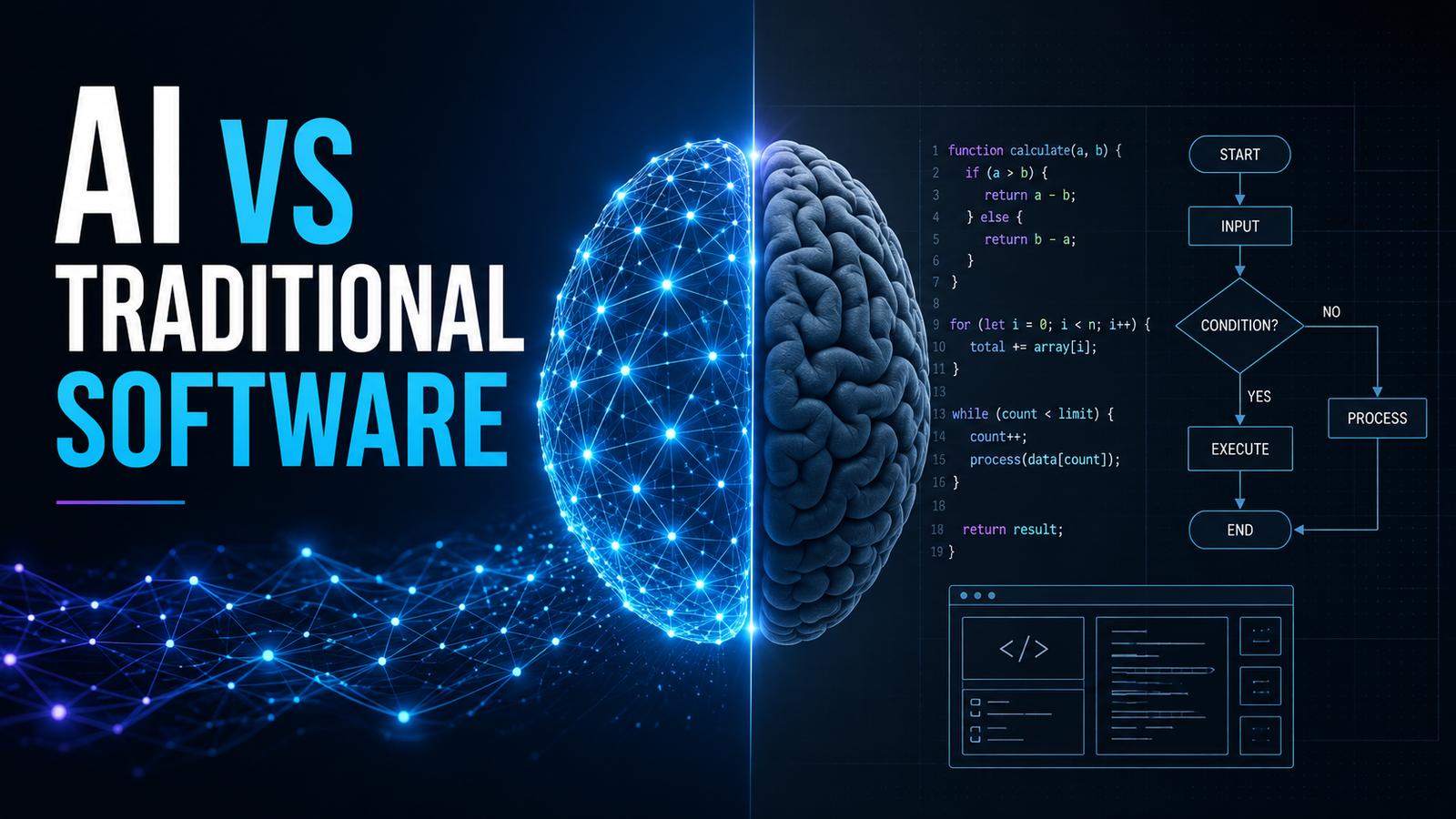
AI vs. Traditional Software: What’s the Difference?
Software is part of almost everything we do, from sending messages and shopping online to managing businesses and studying. However, not all software works in the same way. Some programs follow predefined instructions, while others use artificial intelligence to recognize patterns, generate content, or make predictions.
So, what is the difference between AI and traditional software? In this beginner-friendly guide, we will explain how both approaches work, explore real-world examples, compare their advantages and disadvantages, and help you understand when each is useful.
Table of Contents
- What Is Traditional Software?
- What Is AI Software?
- Key Differences
- Real-World Examples
- Advantages and Disadvantages
- Can AI and Traditional Software Work Together?
- Which Should You Choose?
- The Future of Software
- Frequently Asked Questions
What Is Traditional Software?
Traditional software generally works through instructions and rules written by developers. When a user provides input, the program processes it according to its logic and produces an output.
For example, if you enter 15 + 25 into a calculator, it returns 40. The calculator applies mathematical rules rather than learning how to add numbers from a collection of examples.
How Does Traditional Software Work?
- A developer defines the program's rules and logic.
- The user or another system provides input.
- The software processes the input according to its instructions.
- The program returns a result or performs an action.
Examples of Traditional Software
- Calculators: Perform mathematical operations.
- Inventory systems: Track stock when products are sold or received.
- Payroll software: Apply configured salary and deduction rules.
- Booking systems: Check availability and record reservations.
- Word processors: Let users write, format, and edit documents.
Traditional software can be extremely sophisticated. It can contain complex algorithms, databases, and automated workflows. The key distinction is that its behavior is primarily driven by programmed logic rather than a model that learns patterns from data.
What Is AI Software?
Artificial intelligence software uses techniques that enable computer systems to perform tasks such as recognizing images, understanding language, generating content, classifying information, and estimating likely outcomes.
Many modern AI applications use machine learning. Developers train a model on data so it can identify patterns and use those patterns when processing new inputs. Other AI approaches use different methods, so not every AI system works in the same way.
How Does AI Software Work?
- Developers choose an appropriate AI method and prepare relevant data.
- A model may be trained or configured for a particular task.
- The application receives a prompt, image, document, or other input.
- The model generates a prediction, classification, or response.
- The result may be checked before it is used in another process.
Examples of AI Software
- AI chat assistants: Generate responses and help with language tasks.
- Image recognition: Identify or classify objects in images.
- Recommendation systems: Suggest products, music, or videos.
- Fraud detection: Flag transactions that appear unusual.
- Speech recognition: Convert spoken words into text.
AI is not automatically accurate. A model may misunderstand a question, produce a false statement, or make an unreliable prediction. Results depend on the model, task, data, and safeguards.
AI vs. Traditional Software: Key Differences
Traditional software usually applies defined rules, while AI-based systems may use learned patterns to produce predictions or generated outputs. Here is a comparison of their general characteristics.
| Feature | Traditional Software | AI Software |
|---|---|---|
| Core approach | Primarily programmed rules and logic. | Often uses models trained or configured to recognize patterns. |
| Behavior | Usually predictable for defined inputs and conditions. | May produce variable or probabilistic outputs. |
| Data use | Processes data according to programmed logic. | May use data to train models and produce predictions. |
| Main strength | Consistent calculations and rule-based workflows. | Pattern recognition, language tasks, and predictions. |
| Testing | Tests defined rules and expected results. | Also evaluates accuracy, bias, robustness, and variable outputs. |
| Common risks | Bugs, incorrect rules, and configuration errors. | Inaccurate outputs, bias, and unreliable predictions. |
| Typical uses | Payments, calculations, inventory, and fixed processes. | Recommendations, language assistance, and content generation. |
These are general tendencies rather than absolute rules. Traditional software can be complex, and AI applications also depend on conventional code for data handling, security, and reliable operations.
Real-World Examples of AI vs. Traditional Software
1. Customer Support
A traditional support system might display frequently asked questions or route a customer to a department based on selected options. An AI assistant can interpret questions written in everyday language and generate relevant responses.
Best approach: Use fixed workflows for predictable processes and consider AI for varied questions. Important or complicated cases should have a way to reach a human agent.
2. Online Shopping
A conventional store lets customers filter products by price, category, size, and availability. An AI recommendation system may analyze available behavioral patterns to suggest products a shopper might like.
Best approach: Use filters for precise requirements and recommendations when personalized discovery is helpful.
3. Banking and Fraud Detection
A traditional fraud rule might flag a transaction above a specified amount. An AI model can identify more complex patterns associated with suspicious activity.
Best approach: Combine pattern detection with explicit controls, monitoring, and appropriate investigation.
4. Writing and Content Creation
A conventional text editor helps users type, format, save, and organize documents. An AI writing assistant can suggest outlines, summarize material, or generate a first draft.
Best approach: Use standard editing tools for direct document control and AI assistance for brainstorming or drafting. Review and verify the final content before publishing.
5. Scheduling and Appointments
A conventional calendar can check availability and prevent conflicting bookings. An AI assistant can help interpret a request such as "find a suitable time next week" and suggest options.
Best approach: Let AI interpret flexible requests while dependable scheduling software enforces availability and confirms bookings.
Advantages and Disadvantages of Traditional Software
Advantages
- Predictability: Explicit rules make many workflows easier to test.
- Consistency: The same conditions can be applied repeatedly.
- Control: Developers can define permitted actions precisely.
- Efficiency: Simple tasks may not need an AI model.
- Traceability: Rule-based decisions can be easier to audit.
Disadvantages
- Limited flexibility: Unexpected inputs may not fit existing rules.
- Rule maintenance: Changing requirements may need code updates.
- Ambiguity: Fixed logic may struggle with varied natural language.
- Complexity: Large collections of rules can be difficult to maintain.
Advantages and Disadvantages of AI Software
Advantages
- Pattern recognition: Can identify relationships in complex data.
- Language capabilities: Can interpret and generate natural language.
- Flexible assistance: Can help with a variety of prompts.
- Automation: Can support classification, summarization, and other tasks.
- Personalization: Can tailor suggestions using available context.
Disadvantages
- Inaccuracy: AI may produce incorrect answers or predictions.
- Variable outputs: Similar inputs may sometimes produce different results.
- Privacy concerns: Data handling requires careful consideration.
- Cost: Model access, integration, and monitoring may require resources.
- Bias: Models can reflect problems in data or system design.
- Testing challenges: It can be difficult to define every acceptable output.
Can AI and Traditional Software Work Together?
Yes. Many useful applications combine AI components with conventional software. This hybrid approach allows each component to handle the tasks it is best suited for.
For example, an online shopping assistant might use AI to interpret a customer's request and identify suitable products. Traditional software can then check inventory, verify prices, enforce permissions, and process the order.
Similarly, AI might summarize an email conversation or suggest a reply, while conventional software stores the messages and sends an email only after the user confirms the action.
Why Combine the Two Approaches?
- AI can handle flexible language and pattern-based tasks.
- Traditional code can enforce exact business rules.
- Databases can maintain records and transaction history.
- Validation can catch invalid outputs before important actions.
- Human review can help manage sensitive decisions.
AI or Traditional Software: Which Should You Choose?
Neither approach is automatically better. Start by identifying the problem, the consequences of errors, and the kind of output you need.
Choose Traditional Software When:
- The task follows clear and stable rules.
- Exact calculations and consistent results are essential.
- You need explicit control over permitted actions.
- A straightforward algorithm can solve the problem.
Consider AI When:
- The task involves interpreting everyday language.
- You need to analyze images, audio, or unstructured text.
- Pattern recognition or forecasting could add value.
- You need help generating ideas, summaries, or drafts.
- You can evaluate the output and manage the risk of mistakes.
Five Questions to Ask Before Deciding
- Can a straightforward set of rules solve the task?
- How costly would an incorrect result be?
- Do I have suitable data and a reliable way to evaluate performance?
- Will AI provide enough value to justify its cost and complexity?
- Should a person review the result before an important action?
In many cases, the practical solution is not to replace an entire application with AI. It is to introduce AI only where it solves a specific problem better than the existing approach.
The Future of Software: More AI, Not Necessarily Less Code
AI is changing how software is built and used. Developers can use AI assistants to help write code, explain errors, generate tests, and document projects. Businesses can use AI to help employees search information, summarize documents, and handle routine tasks.
However, AI does not remove the need for good software engineering. Applications still require security, testing, access controls, reliable data handling, and ongoing maintenance.
Understanding when to use AI—and when deterministic logic or human judgment is more appropriate—will remain an important technology skill.
Frequently Asked Questions
1. Is AI the same as software?
No. AI is a field of computing and a collection of techniques used to build systems that perform tasks such as prediction, recognition, and content generation. AI applications are software, but most software does not require AI.
2. What is the main difference between AI and traditional software?
Traditional software generally relies on explicitly programmed logic. Many AI systems use models that learn patterns from data to produce predictions, classifications, or generated content.
3. Is traditional software more reliable than AI?
It depends on the task and implementation. Traditional software can be more predictable for clearly defined rules, while AI may be useful for ambiguous or pattern-based tasks. Both require testing, and both can fail.
4. Can AI work without traditional programming?
AI systems still rely on software and computing infrastructure. AI can help developers write programs, but it does not eliminate the need for programming and system design.
5. Is machine learning the same as AI?
No. Machine learning is a major area within AI that uses data to train models. AI is the broader field and includes multiple approaches, including methods that do not rely on machine learning.
6. Will AI replace traditional software?
AI will continue to change software products and development workflows, but conventional programming remains essential for calculations, records, access controls, business rules, and dependable system behavior. Many applications combine both.
Conclusion
Traditional software and AI solve problems in different ways. Conventional programs are especially useful when tasks can be described through explicit rules and predictable operations. AI can add value when a task involves language, pattern recognition, prediction, or generating new content.
A strong solution often combines both: AI provides flexible assistance, while traditional software handles validation, records, permissions, and precise actions.
If you are learning about technology, begin by understanding the problem a system needs to solve. Then decide whether rules, AI, or a combination offers the most practical and reliable solution.
Keep learning: What Is Artificial Intelligence? A Beginner-Friendly Guide and Best Free AI Tools for Beginners .